
Conversion Rate Optimisation and the Advertising Funnel
What really determines the success of your digital advertising is optimization of your campaigns and landing pages. Do users stay, engage, and take action, or do they leave your ads without converting? Here, conversion rate optimisation (CRO) makes all the difference.
When CRO is used with the advertising funnel, it improves user experience and guides users smoothly from the first click to the final conversion. In this article, we will explore how conversion rate optimisation and the advertising funnel work together, and why optimizing both is essential for sustainable growth in digital marketing.
What Is Conversion Rate Optimisation?
Conversion rate optimisation (CRO) is the process of increasing the percentage of users who complete a desired action on a website. These actions, or conversions, can include purchases, lead form submissions, demo requests, or sign-ups.
CRO can be done in many specific ways. But typically, it involves A/B testing, marketing theories, and personalisation.
The Advertising Funnel
The advertising funnel is a model of how people who see an advertisement become customers. It starts with (1) awareness, when potential customers first discover your brand through ads. As they move further down the funnel, they enter the (2) consideration stage, where they explore your offer, compare options, and decide whether you’re the right fit. Finally, at the bottom of the funnel, users take (3) action: whether that’s making a purchase, signing up, or getting in touch. That action stage can also be called the conversion stage.
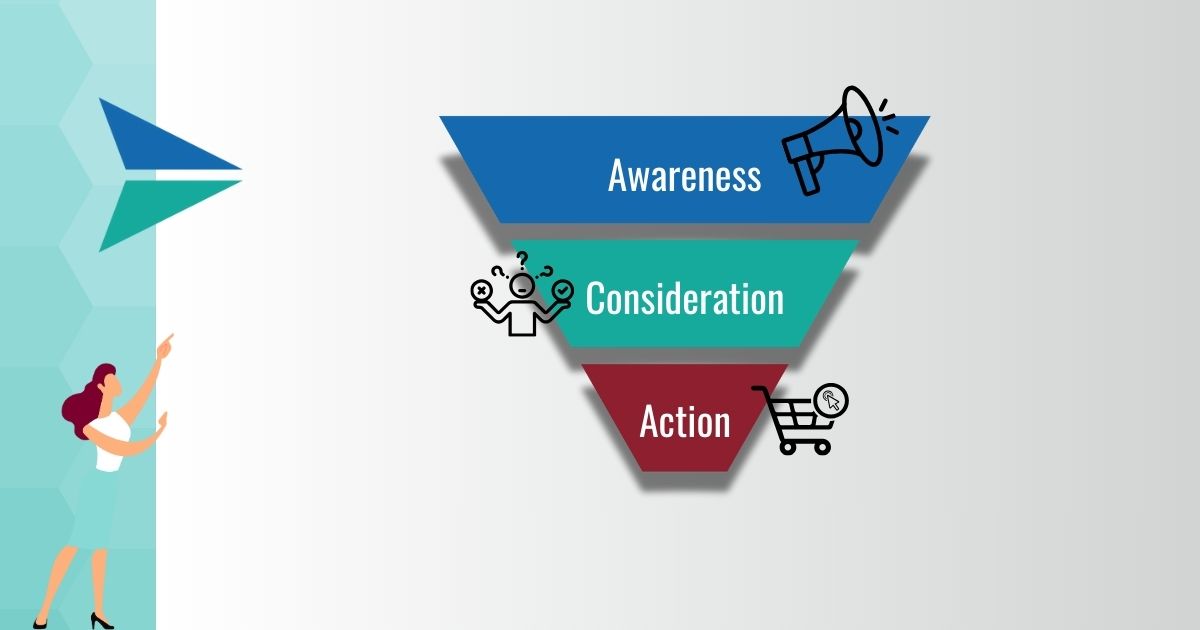
It is important to say that sometimes you may see some funnel examples with 2 “extra” stages:
- Loyalty (4): Ongoing engagement through loyalty programs, exclusive offers, email communication, and social media helps keep customers connected to your brand over time.
- Advocacy (5): Customers who have a positive experience and feel valued are more likely to recommend your brand, strengthening and supporting future marketing funnels.
Loyalty and advocacy are desirable outcomes rather than essential stages of the funnel.
Why CRO Is So Important for the Advertising Funnel
Conversion rate optimisation ensures that paid ads don’t just drive clicks, but drive results. Without CRO, even high-performing ads can fail.
When you perform conversion rate optimisation for the advertising funnel you will see:
- Ad spend becomes more efficient
- Funnel drop-offs are reduced
- ROI increases without increasing traffic
Practical CRO Optimisations Across the Advertising Funnel
Below are high-impact conversion rate optimisation practices, linked to the different stages of the advertising funnel. Effective conversion rate optimisation relies on data, not assumptions. Track performance across the entire funnel, identify drop-off points, and use both quantitative and qualitative insights to guide the ongoing improvements.
Top of the Funnel: Awareness and First Clicks
At the awareness stage, conversion rate optimisation starts. Goal: get attention and improve engagement. This stage supports what conversion marketing is at its core: guiding users from awareness to conversions.
1. Optimise for attention and engagement
Attracting initial attention is the first job of any funnel. The user’s first interaction with your brand must be visually engaging and conceptually clear. If the message or design lacks energy, users scroll past or click away.
Ways to capture attention:
- Use strong visual contrast in ad creative
- Place primary messages in the top third of the design
- Include humor
- Improve hooks
- Keep headlines short and clear
2. Use clear headlines
Headlines guide users through the content and reinforce the message. At the top of the funnel, they should quickly explain what’s on offer and why it matters. Vague or clever wording leads to confusion and drop-off.
Effective headline practices:
- Choosing a font that is clear
- Focus on benefits, not features
- Use everyday language instead of industry jargon
- Make the headline the most prominent element on the page
- Test emotional versus rational phrasing for different audiences
3. Strengthen value propositions in advertisements
If people don’t understand your value instantly, they won’t click. Your ad must show what you offer and why it’s worth their time. A strong value proposition sets the stage for engagement.
Checklist for clarity:
- Communicate the outcome or benefit upfront
- Include a differentiator if possible (e.g. “Faster than X”)
- Use power words that connect emotionally
- Avoid overloading with features or buzzwords
4. Focus on visibility and engagement
Ads that are hard to see or understand won’t drive clicks. Every pixel should work to make your offer clearer and more appealing. Visibility isn’t just about reach, but about on-screen impact.
Make your message stand out:
- Choose high-contrast colours and fonts
- Avoid cluttered designs
- Include dynamic elements like movement or animation
- Use platform-specific best practices for ad placement
5. Optimise website speed
Website speed (fast-loading pages) is critical at the top of the funnel. If a landing page loads slowly, users leave before engaging with your message. Fast-loading pages reduce bounce rates, improve user experience, and increase the likelihood that visitors continue into the funnel.
Key optimisation areas:
- Compress and modernise images
- Reduce unused CSS and JavaScript
- Use Content Delivery Networks (CDNs)
- Enable browser caching
- Choose scalable, performance-focused hosting
6. Match ad messaging to landing pages
Message mismatch is one of the biggest causes of early drop-off. Headlines, visuals, and value propositions on your landing pages should directly reflect the promise made in your ads to maintain continuity and trust.
Best practices:
- Mirror ad headlines and language on landing pages
- Reinforce the same pain point and outcome
- Align visuals with the ad creative
- Remove off-message navigation or distractions
7. Optimise for mobile-first experiences
Most paid traffic arrives via mobile devices. Responsive layouts, fast mobile load times, and clear mobile CTAs ensure that awareness-stage traffic doesn’t leak before engagement begins.
Focus on:
- Responsive design across screen sizes
- Tap-friendly buttons
- Minimal mobile form fields
- Fast mobile load performance
- Consistent testing across devices and browsers
Middle of the Funnel: Engagement and Lead Generation
In the consideration phase, users compare options and seek reassurance. This phase focuses on removing hesitation and building trust.
8. Optimise layouts of advertisements and landing pages
The layout influences how people process your message. Clean, predictable structures keep users focused and reduce effort. Confusing layouts drive uncertainty and exit rates.
Layout improvements:
- Use visual hierarchy to guide attention
- Break long content into digestible sections
- Keep CTA buttons consistently placed
- Limit the number of distractions per screen
9. Improve information on products or services
Once users show interest, they need details to continue. Poor or missing information creates hesitation. Clear, concise, and benefit-focused content keeps the journey moving.
What to improve:
- Use bullet points to explain product benefits
- Include comparisons or FAQs for complex offers
- Provide clear specs, prices, and outcomes
- Avoid walls of text or generic claims
10. Emphasise product or service benefits
Features describe what something is. Benefits describe why it matters. The middle of the funnel is where benefits win. They connect your product to the user’s goals and pain points.
Bring out the benefits:
- Reframe features as outcomes
- Use phrases like “so you can…” to link to value
- Highlight speed, simplicity, savings, or relief
- Use visuals to support the benefit, not just the feature
11. Simplify the user journey
As users explore your offer, unnecessary steps increase friction. Clear navigation, minimal form fields, and logical page flow help users move confidently toward conversion.
Ways to reduce friction:
- Map the journey from entry to conversion
- Remove unnecessary steps or fields
- Use progressive disclosure where possible
- Add visual cues like progress indicators
12. Optimize social proof to build trust
Testimonials, reviews, case studies, and trust badges reduce hesitation during the consideration stage. Social proof reassures users that your offer is credible and worth choosing.
Effective social proof includes:
- Testimonials tied to specific outcomes
- Reviews placed near CTAs
- Recognisable client or partner logos
- Security badges and guarantees
13. Personalise experiences where relevant
Tailoring content or messaging based on traffic source, user behavior, or intent increases relevance. Personalisation at this stage helps users feel understood and keeps them engaged longer.
High-impact personalisation examples:
- Traffic-source-specific landing pages
- Behaviour-based recommendations
- Messaging tailored to new vs returning users
- Contextual offers based on intent signals
14. Add retargeting with relevant information
Most users don’t convert on the first visit. Retargeting helps bring them back with messages that match their behaviour. It turns interest into intent by filling in the gaps.
Effective retargeting strategies:
- Serve product reminders for abandoned views or carts
- Share case studies or testimonials to build trust
- Highlight expiring offers or urgency signals
- Tailor the message to previous actions or time since visit
Bottom of the Funnel: Final Conversions
At the decision stage, CRO has the biggest impact: here CRO generates purchases, subscriptions, or qualified leads.
15. Clarify and position pricing effectively
Price isn’t just a number; it’s a story. How and where you present it changes how it’s perceived. If you can present your prices upfront, clear and logical explanations will improve confidence at the moment of decision.
Pricing best practices:
- Position prices near CTAs or decision points
- Use price anchoring (show higher-priced options first)
- Break down pricing to monthly or per-use cost
- Highlight guarantees or refund policies nearby
16. Use clear, outcome-driven calls to action
At the decision stage, clarity matters more than creativity. CTAs should clearly state what action users are taking and what value they will receive in return.
Strong CTAs are:
- Specific (“Start Free Trial”, not “Submit”)
- Action-oriented
- Visually prominent
- Tested regularly for performance
17. Optimise checkout and form experiences
Complicated checkout flows and long forms are major causes of abandonment. Guest checkout options, fewer required fields, multiple payment methods, and visible security signals all improve conversion rates.
Checkout optimisation priorities:
- Guest checkout availability
- Minimal required fields
- Multiple payment options
- Clear error handling
- Visible trust and support signals
Turning Traffic Into Results With SublimeStart
The connection between conversion rate optimisation and the advertising funnel is what separates brands that simply get clicks from those that generate consistent growth. Advertising brings users into the funnel, but conversion rate optimisation is what turns that traffic into leads, sales, and revenue.
At SublimeStart, we don’t treat CRO as an afterthought. We integrate conversion rate optimisation directly into the advertising strategy, ensuring that every click, landing page, and user interaction converts. From website conversion rate optimisation to full-funnel conversion optimization marketing, our approach is data-driven, strategic, and focused on real business outcomes.
Whether you need a dedicated conversion rate optimizer, better-performing landing pages, or a smarter conversion marketing strategy, we help you maximize results without increasing ad spend. Let SublimeStart turn your visitors into customers. Get in touch today to improve your conversion rate with a strategy built for growth.